How far did the war change
people`s attitudes about how
big a part a government should
play in peoples`s lives ?
By
(University College Northampton, England)
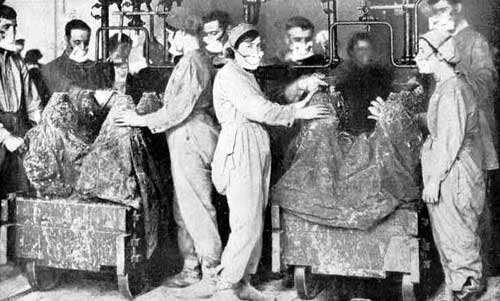
British war workers wearing gasmasks while loading shells with poisonous chemicals
“War” declared Trotsky, “is the locomotive of history” (Bourne, 1989, p.191)
When considering the attitude of the people towards the change governmental intervention had in their lives, one must consider a number of different aspects.
The scene must firstly be set by ascertaining the mood of the people upon the outbreak of war, and this Bourne eloquently describes:
“The British urban working class was the oldest industrial workforce in the world. Its class-consciousness was very strong. It was well organised. It had a sharp awareness of its industrial strength. It was quite remarkably strike-prone. It was also riven with divisions, petty snobberies and subtle distinctions. It was disciplined and deferential, conformist and hedonistic, patriotic and loyal. It showed little interest in radical ideologies. It had a vast fund of goodwill towards Britain` s national institutions, especially the monarchy and parliament. From the point of view of a hard- pressed government in time of war, the working class was far from intractable. There was, however, a sticking point. This was `fairness`, a concept deeply rooted in Anglo-Saxon culture. Government could ignore `fairness` only at its peril.
(Bourne, 1989, p. 204)
These were the people the government were given the task of cajoling into acquiescence, people that had become accustomed to Free Trade, private enterprise and minimal governmental interference. Despite this scenario however, political Liberalism was seen to be evolving in response to social problems and the rise of labour, and the war became “the locomotive” which accelerated the change in British politics and society.
It was only when the pressures of war were brought to bear, that the government gradually abandoned its laissez faire principles in favour of direct control. The goal was to fight a war, but simultaneously preserve the living standards of the civilians, so as to uphold morale on the home front and in the factories needed to supply the military front.
Bourne suggests that:
“The nature of this interference was characteristic. It involved a series of ad hoc responses to specific problems. These were made of necessity and not through choice. There was no overall plan and no philosophy of action.”
(Bourne, 1989,p. 192)
The desperate need for munitions was an early realisation of the need for state control, which later extended to shipping in 1916, food in 1917,coal in 1917, and food rationing in 1918. Both Lloyd George and Asquith` s ministries were reluctant to affront public opinion, especially the trade unions, consequently a careful pace was adopted along with the contingency of `returning to normal` at the conclusion of the war. The government were unwilling and unable to compel men to join up, and the ability to control labour was even more problematic, due to the increasing power and self-confidence of the trade unions. The union ideology was based on free collective bargaining, sensitivity to the prerogative of its workers and opposition to the introduction of new technology, consequently Britain lagged behind in production of iron and steel, coal and chemicals, all of which could be a distinct disadvantage in a war against its main European competitor.
The British experience was that it was impossible to fight a major modern war without compulsory military service. Kitchener `s adherence to a `volunteer conscripts only` policy until as late as 1916, was probably a factor in prolonging the war and it became increasingly difficult to maintain the supply of men for the front, thus the govt resorted to measures, which many saw as a betrayal of the notion of `fair play.` The indiscriminate nature of volunteering meant that many `quality` workmen were enlisting, leaving an acute shortage, especially in the munitions industry.
The Board of Trade Report on State of Employment in United Kingdom, July 1915 showed that:
“Almost a quarter of the employees in the chemicals and explosives industry had enlisted, as had a similar proportion from electrical engineering; over a fifth had gone from coal-mining and almost as many from the metal trades.”
(Marwick, 1967,p.58)
Marwick further observed that
“In a `war of machines` it was at least as necessary to look to the supply of machine -makers at home as to the supply of machine-users on the fields of battle.”
(Marwick, 1967, p.58)
There was an attempt to alleviate the manpower shortage with the issuing of badges for those men deemed to be engaged in `essential occupations`, and the compilation of a National Register for all persons between the ages of fifteen and sixty five in order to co-ordinate the war effort. Armed with this information, the government proposed a number of bills which deemed that single men, besides those who had `attested “ to volunteer if needed, had enlisted and were eligible for transfer to the Reserve. In light of this inadequate ` semi-conscription`, a new universal conscription Bill was introduced which eventually became law.
“ The imposition of universal conscription was an event of central importance in the social history of the war. It implied a definite swing in the Government policy from the careful hoarding of its skilled labour to a prodigal casting of copper, silver and gold into the lottery of the trenches; it meant that the highly controversial `dilution` which had been designed to maximise the domestic labour force now became `substitution`, the attempt to release the able-bodied by employing the less able - bodied.”
(Arthur Marwick, 1967, p.83)
Lloyd George was compelled to open up hitherto skilled jobs to unskilled labour, and bring women into industry in vast numbers. The Trade Unions feared an erosion of their hard-earned power, the erosion of differences between skilled and unskilled workers, the driving down of wages by unscrupulous employers utilising women.
Both employers and the government were in a quandary. The former were competing for labour in a seller` s market and would have to offer higher wages and better working conditions. The latter would have to co-operate with the Trade Unions and share political decision-making. The TUC had craved recognition and responsibility since its inception, and now a golden opportunity had presented itself. The Treasury Agreement discussed from 17-19 March between Arthur Henderson and his trade union leader colleagues on one side, and Chancellor of the Exchequer, Lloyd George and President of the Board of Trade, Walter Runciman on the other, meant that the unions agreed to `dilution of the restrictive practices` and compulsory arbitration. The government for their part agreed to maintain the skilled wage rate even when performed by an unskilled person, and limit private profits.
“This, however, did not in practice amount to much; for the limitation was only on excess profits above the pre-war level, and the pre-war standards were so defined, by allowing firms to select their most profitable years to form the basis of an average, that munitions firms were not only able to make but also to retain very high profits in spite of the Government` s promise.”
(Cole & Postgate,1956, p.515)
The new coalition government at once created the post of Minister in the Ministry of Munitions for David Lloyd George, and almost immediately sought to legalise the Treasury Agreement by presenting the Munitions of War Act before the House.
The Ministry of Munitions was to take control over those factories engaged in war production under the Defence of the Realm Act, thus suspending trade union practice, in accordance with the Treasury Agreement, for the duration of the war.
The suspicion that employers would try to outbid each other for the limited supply of skilled workers, was addressed by issuing a` leaving certificate` to an employee to enable him to change his job, if he had been engaged in munitions work within the previous six weeks, and at the consent of the previous employer. There was, however, no protection for the worker from dismissal by the employer, and this procedure became a standing grievance amongst the work force. Moreover, the certificate interfered with the skilled man` s opportunities to earn higher wages in view of the labour shortage.
In this way, not only could the government manage labour and supply the trenches, it could also select men whose removal from the workforce would be the least detrimental to war production. Those found guilty of provoking industrial unrest soon found themselves on the front line. The disruption of war production through strikes and industrial action was prohibited, and all differences were to be solved by compulsory arbitration, the Local Munitions Tribunals, a body with the power to appeal against the refusal of employers to grant leaving certificates, and to impose fines on workmen who attempted strike action or hindrance of munitions production.
The Munitions of War Act gave the ministry extensive powers, which also stretched into the economy as a whole, power supply and the control of raw materials. The Ministry` s aim was to encourage good industrial practice, adopt the latest methods and machinery, hence the conversion to Arc furnaces from Bessamer converters in the steel industry. Industrial specialisation, research and development, production analysis and modern systems of financial control were positively encouraged, and this also gave private manufacturers the opportunity to effect changes previously blocked by trade union opposition. Many industrial processes became standardised, new machinery created, and scientific research was rescued from neglect with encouraging results. However, the government` s foray into other areas of British industry yielded mixed results. The railways were taken over to introduce some kind of standardisation amongst the 130 companies. The coal industry meanwhile experienced a `de facto` nationalisation, which yielded little in the way of technical innovation, increased productivity or output. The dangerous nature of shipbuilding restricted women and the unions fought dilution. The drive to adopt good practice in agriculture yielded few results, farmers did not utilise their new women workers for one thing, or produce enough to adequately feed the nation without the imports secured by merchant seamen and their Navy escorts.
The Ministry assumed the role of industrial employer in its own right, establishing factories with public funds on specially acquired land, and paying great attention to employee health and welfare, catering, washing and recreation, which in turn raised the standards of private manufacturers. Industrial discipline was vital, and there were fines for poor workmanship, lateness and absenteeism. Sobriety was promoted by heavy alcohol taxes, the imposition of licensing laws, which survive to this day, and the rising cost of living was curbed by rent control (The Rent Restriction Act of 1915) in order to avert strikes, which would hamper war production. This measure, however, failed to have the desired effect due to the arbitrary nature of its compulsion, the fact that the loss of profits would retard new house building and thus lead to overcrowding, consequently raising the incidence of tuberculosis, and general civil unrest. The government took responsibility for the incomes of the populace, whose means had been cut by the war. The post war separation allowances, widow ` s pensions, ex-servicemen disabled benefits, `making up` the shortfall of cotton operative` s wages, `dole`, all extended the government` s responsibilities in the field of income maintenance permanently.
“I am disinclined to admit that all the measures of industrial and commercial organisation adopted during the war, which are commonly lumped together under the term state control, were merely necessary evils to be got rid of as soon as possible and never to be thought of again. A considerable extension of the co-operative and collective enterprise seems to me probable and desirable in times of peace; and I believe that there is something to be learnt from the experiments in state control during the war which may be of positive value in the difficult times ahead.”
(Lloyd, 1924, preface in Milward, 1984, p. 22)
From mid 1916, when the Munitions of War Act, and the Military Service Act began to bite, working hours were increased alongside production targets. The news from The Front was bad, the Somme, Jutland etc. and a reportedly growing movement for a negotiated peace, all added to `war-weariness` and the fragile truce between the workers and their government disappeared in 1917, after a severe winter of food and fuel shortages sparked a wave of industrial unrest. The strikes were ended by firmness and concession, and arrests were made under Regulation 42 of the Defence of The Realm Act (DORA)…”impeding the production of war material “
The leaders were in fact shop stewards, not the trade union national leaders whose “collaborationist policies” failed to represent grievances of the local rank and file, which were first and foremost, the high price of food and its unequal distribution. Resentment grew as the workers began to feel that they were suffering disproportionately, their mobility constrained, wages falling behind prices, whilst the employers were making fat profits that the workers were entitled to share. The conciliatory nature of wage increases meant in effect that the improved living standards
“were won through the rising influence of organised labour in both political and industrial sectors”
(Whiteside, 1988, p. 95)
Moreover, these conciliatory measures were given against a backdrop of Bolshevik revolution in Tsarist Russia, the fear of it spreading to Britain, and Russia` s exit from the war.
On the Clyde, regarded as a potential hotbed of revolutionary fervour, strikes broke out as many were complaining that `dilution`, was being extended from government to private work, and that the practice was not being used to release men for `essential tasks`, but for `cannon fodder` in the trenches. Thus the services of women were dispensed with at the end of the war in order to restore industrial peace.
“Victory went to those nations best able to mobilise the people and keep them believing in the war.”
(Gerard J De Groot, 2001,p.135)
Nevertheless, the movements furthering the rights of both women and trade unions saw an improvement in their relative positions during the hostilities. The trade union movement emerged with a great deal of status, self- confidence and power. Its co-operation during the war effort was vital, the smaller unions amalgamated into larger ones and some of its leaders found themselves in important positions in deciding post war matters. The importance of the unions was reflected in a huge increase in new membership, due in part to the successes of collective bargaining. The war had shown how direct action was the most useful method of redressing any perceived grievance.
“The membership grew from 4 million at the start of the war to 6 million at the time of The Armistice, peaking at 8.3 million in 1920- almost half the working population”
(G.R. Askwith, 1974, pp414-46)
“The extension of the franchise in 1918 and the growth of trade union membership offered the poorer sections of the working population the chance to preserve the very real gains they had made during the war. Britain` s workforce emerged from the war more homogenous, less poverty stricken and more organised than it had been in1914.”
(Whiteside, 1988, p. 96)
Women had always worked in light industrial and domestic spheres, but the imposition of male conscription gave women an opportunity to move into traditionally male preserves. In many cases these were not `new` workers:
“Contrary to propaganda reports of the time there was no enormous influx of non-working women into men` s jobs: millions of working class women in Britain moved into different trades when the opportunity arose.”
(Gail Braybon, 2000, p.154)
The effect of this was that the disparity between male and female wages was eroded from half to two-thirds the male wage by the end of the war. The post war years saw trade unionists remaining hostile to the principal of equal pay for equal work, and as many as “two thirds of the women who entered employment during the war had left it by 1920.”
(Bourne, 1989,p. 197)
Keith Robbins suggests that there was an expectation amongst women that their war work was a temporary measure, and this probably suited many women who wanted to return `to normal` as soon as possible. Almost as a reward for their unstinting effort, parliament introduced the Representation of the People Act in February 1918, which in effect extended the franchise to all women aged 30. By this stage Robbins argues:
“The losses sustained in the war made it apparent that there was important work ahead for women. Perhaps it was the case that the factory turned their sex into one united family- a surrogate experience for the trenches, it was claimed-but when peace returned there was an undoubted need for the reproduction of real families.”
(Robbins, 1985, p.161)
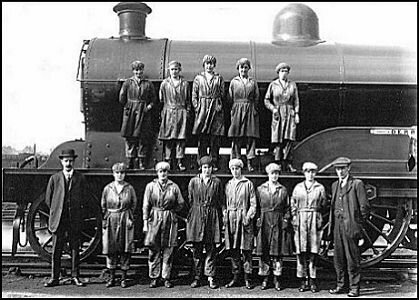 Some saw it as a hollow victory, but the suffragettes saw it as the first step to full voting equality with men. The same year saw the emergence of the Sex Discrimination Act, and by 1921, women were allowed into the jury service, the magistracy, the legal profession, and Nursing was given professional status.
The gains were not perhaps particularly revolutionary, but they were a start, but a lot of ground gained during the war was lost upon the return of the soldiers. However, there were continuing opportunities in clerical work and fresh ones in the higher professions. Women` s maternal and welfare provisions were improved in factories that hitherto failed to cater for factory acts, due to the belief that to legislate for the adult male reflected on his manhood. but perhaps the most important development in hindsight was the significant change in the belief of women, and indeed society, of what they were capable of.
“Now that they were earning on their own account, they had economic independence; now that they were working away from home,…they had social independence. Above all, in their awareness that they were performing arduous and worthwhile tasks, were living through experiences once confined only to the most adventurous males, they gained a new self-consciousness and a new sense of status.”
(Arthur Marwick, 1967, p.99)
Alan S. Milward cites A.L. Bowley in his analysis of this change,
“The economic position of women and their more complete enfranchisement, would no doubt have developed in a different manner if their claims had not been substantiated by their ability to replace men.”
(A.L. Bowley, 1930, p. 22)
However, De Groot maintains that the fact that women were still paid less than men when doing the same job increased tension between the sexes and did nothing for equality. They never attained the status of skilled workers, the real source of power in the labour hierarchy, and were consequently expendable. Many women were contented to return to their homes after the war, and very few found the opportunities to take advantage of their greater self-esteem. Their work in the munitions industry was not universally welcomed and few concessions were made regarding separate changing and washing facilities.
“There is a serious flaw in the argument that women can gain status in society taking up men` s jobs. Status in a patriarchal society is calculated according to a male-orientated measure of importance. If a job becomes essentially `women` s work`, it` s status declines, a decline highlighted by the lower pay attached to it.”
(De Groot, 2001 p 156)
The returning clerks saw their jobs had been taken by women in their absence at the front, and consequently declined to return to them as they were now cast-off jobs to be left to women, who were paid less.
“Britain witnessed perhaps the least disruption to civilian society during the war. Living standards were maintained and the centralised distribution of food supplies and rationing ensured that diet and nutrition, notably amongst the poorest in society, improved dramatically. British workers gained by the war, using their role in war production to force improved pay and conditions, as well as a greater participation in government.”
(Cawood & McKinnon- Bell, 2001, p. 53)
Arthur Marwick`s thesis, however innovative and valid, was formed almost thirty-five years ago, and revisionist historians now feel that Marwick has perhaps over emphasised change at the expense of tradition.
“Thirty years later, these excessively sanguine theories of war and society seem over-cooked. War had some profound (even positive) effects, but it is reckless to postulate an all- embracing theory of war and its effects on society. In more stable societies like Britain and France, forces of conservatism and tradition were probably equal to the challenges of war. When one studies World War One, needs to be aware not just of the forces of change. but also of the countervailing forces which constrained or absorbed change. Progress was profound, but so was the power of convention, tradition, authority, repression and nostalgia.”
(Gerard J De Groot, 2001, p.155)
De Groot further points out that the progress made by the workers depended on labour shortage, and that this power only lasted as long as the vagaries of the trade cycle were favourable. Workers willingly made sacrifices for the good of the country but `only for the duration` and De Groot finds it is hard to see a group of people who sacrificed their lives and their rights to be seen as making progress.
“War is an extraordinary event which engenders a temporary tolerance for disruption. With the armistice comes a widespread desire, amongst all classes, to return to normal. The extent to which normality is restored is the gauge of how worthwhile the sacrifice was. War is seldom fought to change society, but more often to preserve it.”
De Groot p.158-159)
In returning to the question at hand, it seems that the British people were prepared to go along with the increase in government intervention for the duration of the war, and to extricate as many concessions from the government as possible in this period, but it was only for a mutually understood period commensurate with the duration of the war. The British public were conservative in their views, and fought the war, as De Groot stated, to preserve society. Just because the government had been effective running the war, it did n` t mean they would be as effective running the peace.
“The degree of state control eventually achieved during the course of the war was striking and impressive. It encompassed all Britain` s basic industries. The British people showed remarkable readiness to accommodate themselves to the fact of this change. This readiness was not, however, extended to the question of principle. State control was not an idea whose time had come, but an exceptional measure for exceptional circumstances, to be abandoned when the world returned to its senses. The power of the responsibilities of government increase, but the nature of The State was not transformed”.
(Bourne, 1989,p. 193)
Bibliography
GR.R. Askwith, “Industrial Problems and Disputes (New York: Harper & Row, 1974) in Noel Whiteside, “The British Population at War” in “ Britain and the First World War” John Turner (ed), (London, Unwin Hyman, 1988)
J.M. Bourne “Britain and The Great War 1914/1918” (London, Edward Arnold, l989)
A.L. Bowley, ”Some Economic Consequences of the War” 1930 in
Alan S. Milward, ”The Economic Effects of the Two World Wars on Britain” Second Edition (London, Macmillan, 1984)
Gail Braybon, “Women, War and Work” in “The Oxford Illustrated History of the First World War” Hew Strachan (ed.) (Oxford, Oxford University Press, 2000)
Cawood & McKinnon- Bell “The First World War” (London, Routledge, 2001,)
G.D.H. Cole and Raymond Postgate, “The Common People 1746-1946”, (London, Methuen & Co. Ltd., 1956)
Gerard J De Groot, “The First World War”(London, Palgrave, 2001)
Peter Dewey, “The New Warfare and Economic Mobilisation” in
“ Britain and the First World War” John Turner (ed), (London, Unwin Hyman, 1988)
E.M.H.Lloyd, “Experiments in State Control (1924) in Alan S. Milward, ”The Economic Effects of the Two World Wars on Britain” Second Edition (London, Macmillan, 1984)
Arthur Marwick, “The Deluge” (London, Pelican, 1967)
Alan S. Milward, ”The Economic Effects of the Two World Wars on Britain” Second Edition (London, Macmillan, 1984)
Keith Robbins, “The First World War”(Oxford, Oxford University Press, 1985)
Noel Whiteside, “The British Population at War” in “ Britain and the First World War” John Turner (ed), (London, Unwin Hyman, 1988)