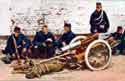
 | Belgian War Dogs Belgium was the only European country that used dogs to draw mitrailleuses.
The rubber-tired gun carriage is in strange contrast with the bizarre appearance of these dogs of war, tired out after a stiff march. |
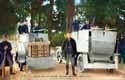 | Ready for the Enemy Belgian armored motor cars. The car on the left carries a machine gun. The one on the right is simply armored with sheet steel to stand heavy fire.
The original caption with this picture reads: The flat lowlands of Belgium and northern France are networked with perfect roads, making possible very rapid movement of troops. Armored motor cars have been much used by all the armies, especially as escorts for aviators. |
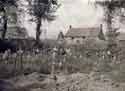 | War Cemetery A War Cemetery in the Belgian village of Woesten.
The village is just behind the frontline, not far from Ypres in Flanders.
Picture made in 1917. |
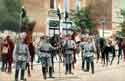 | Occupation Force in Brussels Prussian Hussars in the Belgian capital of Brussels.
The color of the pennon on top of the lance shows from what state of the empire these German hussars come from: this is the Prussian black-and-white.
Hussars were light cavalry. |
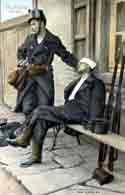 | Wounded Belgian Soldier Belgian soldier standing by a wounded comrade. |
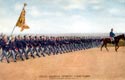 | Crack Austrian Infantry Austrian soldiers from Vienna parade. The long trousers worn by these troops show that they are recruited from the Germanic part of the empire, but for the Austrian army.
The The Austrian empire (in which 26 different languages were spoken) had a large army. Military service was compulsory for all able-bodied males from 20 tot 43, and totalled twelve years: three in the line, seven in reserve and two in the Landwehr. |
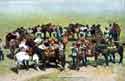 | Rough Riders of Russia The Cossacks of the river Don area pay no taxes, but are liable to military service from 18 to 50 and each must furnish his own horse.
On the picture they show the hollow circle formation, their favorite one for defense. It did not help much against the German machineguns. |
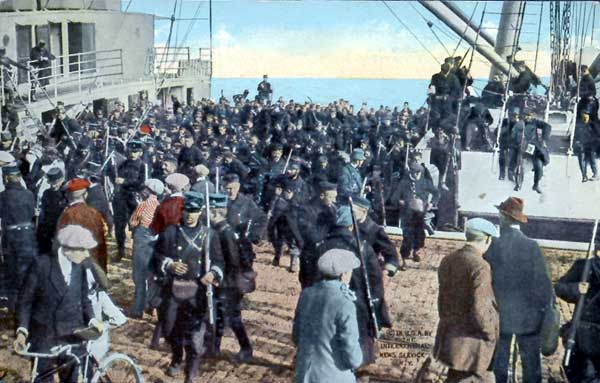
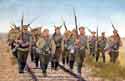 | Marching with Long Bayonets Russian regulars on the march trough Galicia.
American picture (made by a photographer of Underwood & Underwood). The original caption reads:
The Russian infantry is famous for close fighting with the bayonet, which is made a part of the gun and cannot be removed. The faces of the men are a distincively Slavic type. They are patient, enduring, brave, and fight with a stubborn tenacity which has wrecked the hopes of every general in history who attempted the invasion and conquest of their territory. |
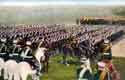 | Russian Steam Roller The Russian Grenadiers of the Guard, the Czar's crack regiments.
There were twelve regiments of these Grenadiers, all composed of big men.
The picture shows a formal review, the regimental band playing parade music as the Guard marches by.
Only a few days before the war broke out, President Poincaré, of France, reviewed these famous troops of the Czar in St. Petersburg. |
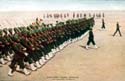 | Indian Troops Immediately after the beginning of the war England shipped 70,000 native troops from India to Europe.
There they came: Sikhs and Ghurkas from the Himalyas, Bengal lancers from the Ganges, and Mahrata infantrymen from the torrid central plains.
They continued to wear their turbans even where the remainder of their uniform was khaki.
And, of course, the helmeted officers are Englishmen. |
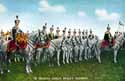 | Death's Head The Prussian Crown Prince's Regiment.
The German Crown Prince is always colonel of the Death's Head Hussars and when he had a difference with his father a couple of years before the war, the Kaiser exciled him to his command at Danzig, where the regiment was permanently stationed.
In state reviews the Crown Prince often appeared in her Death's Head uniform as honorary colonel.
The text on this German postcard reads in translation: Naturally, German noblemen are eager to join this regiment, which is one of the best organisations of the Prussian army. |
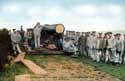 | The New German Siege Gun The Surprise of the War: these German siege guns that battered Namur into ruins, reduced Meubeuge and were employed in the capture of Antwerp.
American picture (made by a photographer assocociated with Brown Bros.). The orignal caption reads: The Germans demonstrated their marvelous efficiency in the art of war by keeping the existence of these fort-destroyers a complete secret until they were ready to use them against Belgium and France.
The guns were transported in sections by rail as far as possible, and then by great traction engines.
The block of wood in the cannon's mouth protects the chamber from dust and rust. |
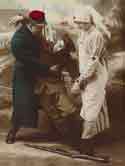 | Protege French picture, 1915, obviously faked.
The text on this color postcard reads:
O Dieu, protège bien nos amis, nos blessés,
Fais-les renaître enfin sous nos soins empressés.
Translated that is:
O Lord, protect our friends, our wounded.
Revive them at last under our hasty care |
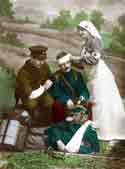 | Courage Another picture from the same French series.
The caption reads: Courage & Dévouement
That is: Courage & Devotion. |
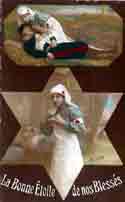 | La Bonne Etoile From a similar French series.
La Bonne Étoile de nos Blessés means The Good Star of our Wounded.
Of course the scene is completely faked. Female nurses never entered the battlefields. |
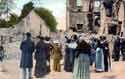 | Ruins of Senlis Before Rheims, Senlis (Northern France) was razed to the ground by the German army.
It was a beautiful Old World town.
Picture made in 1914 by a photographer of the American International News Service. |
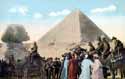 | Taking the war to the pyramids New Zealanders on camels in Egypt.
Picture made by a photographer of the Underwood & Underwood Agency, New York.
The soldiers have lemon squeezers on their head. This kind of headwear was worn only by New Zealand troops. |
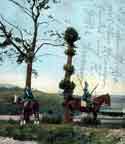 | Uhlans on Watch German Uhlans on the lookout.
Postcard with some writing on it. |
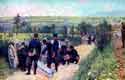 | French 75's 'Notre 75 en action', is the original caption on this French picture.
The 75's were much used French fieldguns.
It is a real photograph but poorly handcolored afterwards. |
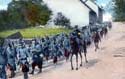 | On the Move 'French soldiers moving on the enemy's flank', is what the photographer of the Underwood & Underwood Agency wrote down on this picture. |
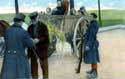 | Refugees Peasants fleeing from the city of Louvain on hearing of the approach of German forces.
Picture made in 1914 by a photographer of the American Underwood & Underwood Agency. |